The Arrival of Marie de Medici at Marseilles
Artwork by Peter Paul Rubens • 1622
🖼️ Reproduce this artwork — 📗 Book on Peter Paul Rubens on Amazon
About this artwork - painting analysis
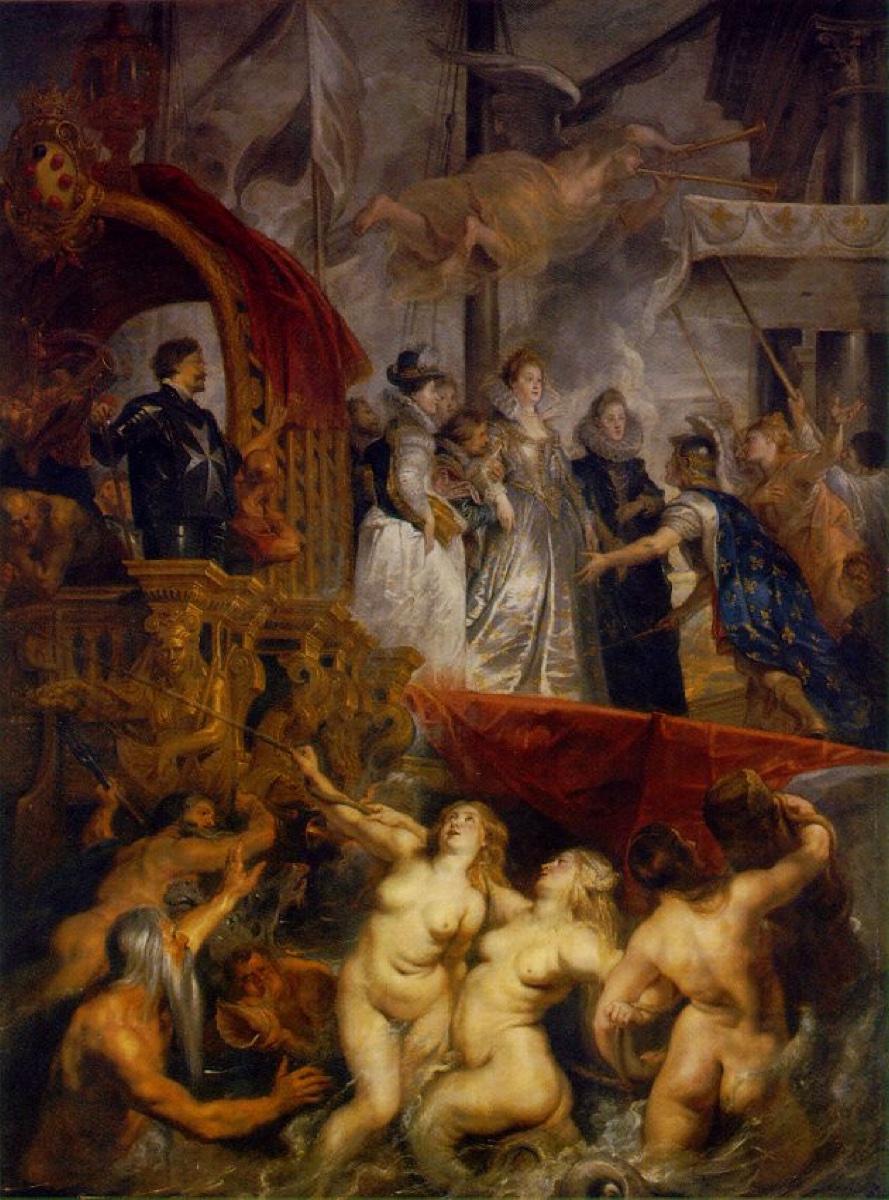
Commissioned by the queen mother herself to glorify her reign, The Arrival of Marie de Medici at Marseille by Peter Paul Rubens constitutes one of the twenty-four monumental paintings in the cycle dedicated to the sovereign. This oil on canvas of spectacular dimensions – nearly four meters in height – celebrates the disembarkation of the Florentine princess in November 1600, who came to marry Henry IV and seal the alliance between France and the powerful Medici family. Rubens transforms this historical moment into a triumphal allegory where the real and the marvelous merge in a vertiginous composition.
The Flemish Baroque painter deploys his genius for theatrical staging here by orchestrating two distinct narrative registers. In the upper section, Marie de Medici descends majestically down the ship's gangway, dressed in white and gold, welcomed by French dignitaries in sumptuous costumes of deep blues adorned with fleurs-de-lis. The crimson red baldachin and the allegory of France – recognizable by her armor and blue mantle – underscore the solemnity of the event. In counterpoint, the lower register reveals a mythological ferment where three nereids and several tritons emerge from the waves, their muscular and sensual bodies symbolically guiding the royal ship toward the Provençal shore. This aquatic celebration, typical of Rubenian imagination, instills cosmic vitality into the historical scene.
Rubens' pictorial technique reaches its apex here: the pearlescent flesh of the marine deities contrasts with the shimmering fabrics of the court, while golden light unifies the whole in a chromatic harmony dominated by warm ochres, imperial reds, and royal blues. The broad and energetic brushstrokes give the painting this whirling dynamism characteristic of triumphant Baroque.
Held in the Louvre Museum since the French Revolution, this masterpiece completed in 1625 perfectly illustrates how Rubens reinvents history painting by blending political propaganda, decorative splendor, and technical virtuosity, establishing a model of Baroque grandiloquence that would durably influence European art.
If you appreciate "The Arrival of Marie de Medici at Marseilles" and other paintings by Peter Paul Rubens, we offer you 10% off the purchase of an art poster from our partner europosters with the promo code GRANDSPEINTRES10.
Image license: faithful photographic reproduction of a two-dimensional public domain work of art.