
Bacchus
Artwork by Le Caravage • 1595
🖼️ Reproduce this artwork — 📗 Book on Le Caravage on Amazon
About this artwork - painting analysis
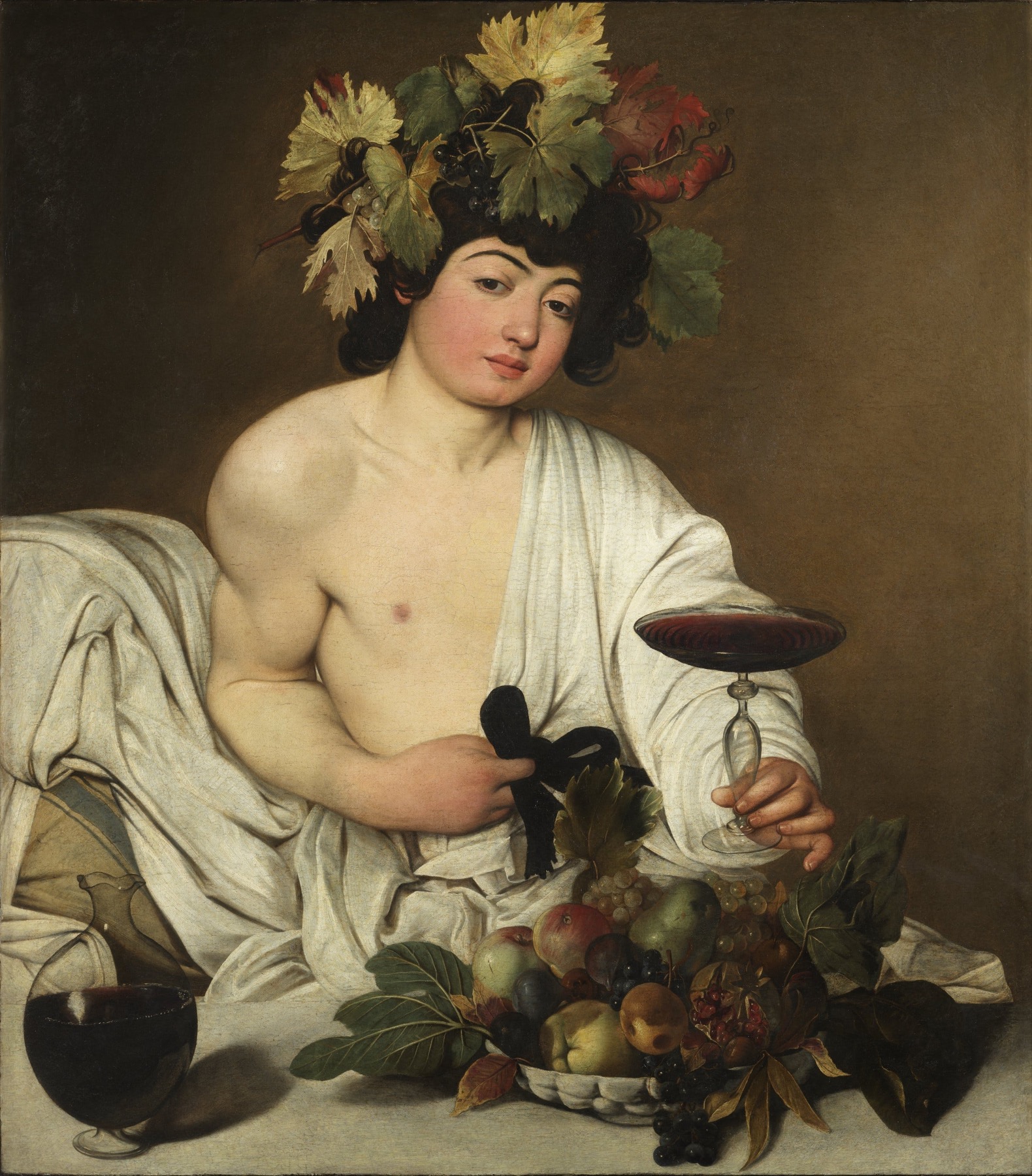
Painted in 1595 by Caravaggio, Bacchus embodies one of the most audacious representations of the Roman god of wine and drunkenness. Far from the idealized images of classical Renaissance, the young Michelangelo Merisi proposes here a terribly carnal and sensual vision of ancient divinity. The model, probably Mario Minniti – friend and collaborator of the painter – poses half-naked, draped in an immaculate white toga that slips off his shoulder, revealing a youthful torso with milky complexion. His head is crowned with vine leaves and grape clusters, traditional attributes of the god, while his right hand raises a cup of red wine that he seems to offer to the viewer in an ambiguous gesture of invitation.
The composition strikes with its starkness and gripping realism. Over a table covered with white cloth unfolds a sumptuous still life: ripe or slightly damaged fruits, burst figs, half-open pomegranates, black and white grapes. This attention to detail, to organic imperfections, characterizes Caravaggio's radical naturalism, which refuses systematic embellishment in favor of raw truth. The neutral background, in ochre and brown tones, concentrates all attention on the central figure, while the raking light – signature of the Lombard master – sculpts the volumes and accentuates the contrast between shadow and clarity.
Created during the artist's early years in Rome, this canvas testifies to the emergence of tenebrism, a technique that would revolutionize European Baroque painting. Caravaggio already develops here that dramatic chiaroscuro which will become his distinctive trademark, influencing generations of artists throughout the continent. Housed in the Uffizi Gallery in Florence, Bacchus remains a profoundly disturbing work through its latent eroticism and its provocative humanization of myth.
This singular interpretation continues to fascinate through its timeless modernity, establishing Caravaggio as a precursor of an unvarnished representation of the human condition, divine or mortal.
If you appreciate "Bacchus" and other paintings by Le Caravage, we offer you 10% off the purchase of an art poster from our partner europosters with the promo code GRANDSPEINTRES10.
Image license: faithful photographic reproduction of a two-dimensional public domain work of art.


