
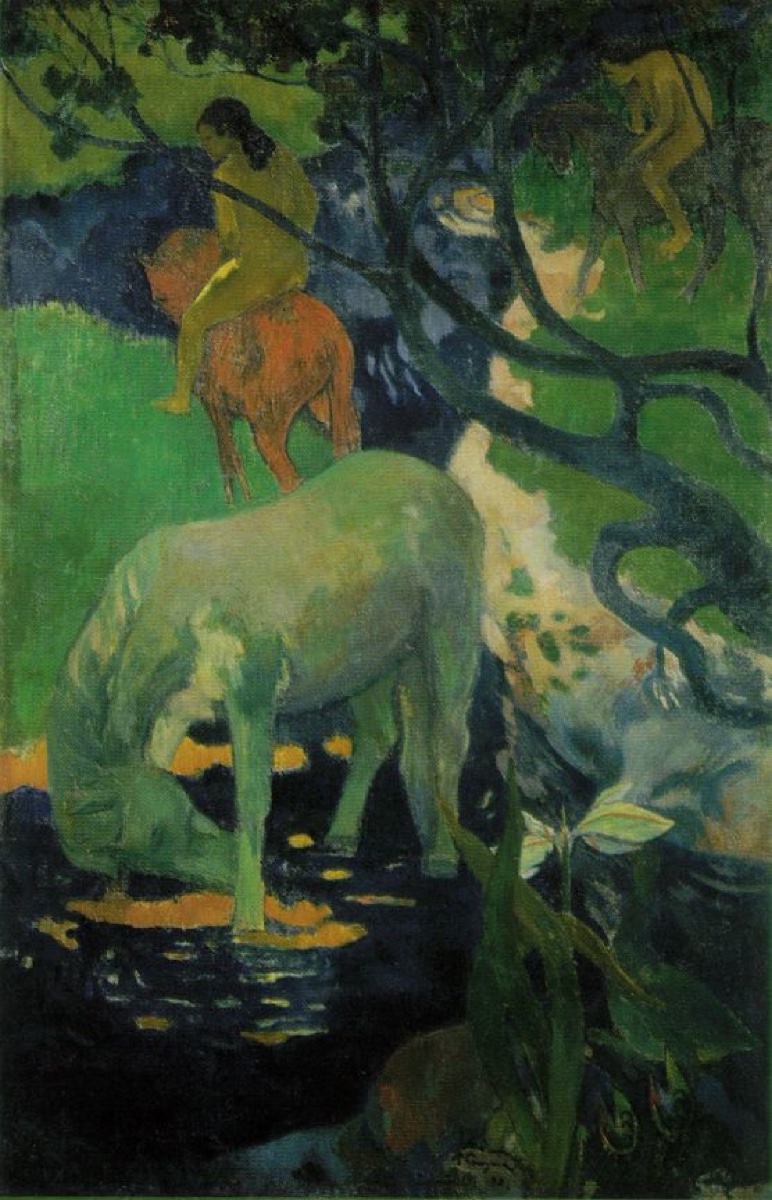
The White Horse
Artwork by Paul Gauguin • 1898
🖼️ Reproduce this artwork — 📗 Book on Paul Gauguin on Amazon
About this artwork - painting analysis
Painted in 1898 during Paul Gauguin's second Polynesian stay, The White Horse stands out as one of the major works of the French artist in his quest for primitive and authentic art. This monumental canvas unfolds an enigmatic scene where a greenish-white horse drinks peacefully from a dark pool, while riders are silhouetted in the background beneath the lush foliage of tropical trees. The fragmented composition and flattened perspective testify to Gauguin's deliberate rejection of Western academic conventions, privileging a symbolist vision where reality transforms into a dreamlike universe.
The dominant tonalities oscillate between intense greens, deep blues, and warm ochres, creating a saturated atmosphere that evokes the tropical humidity of Tahiti. Gauguin applies paint in broad flat areas, refusing traditional modeling in favor of juxtaposed color zones that structure the pictorial space. This cloisonnist technique, inherited from his collaboration with Émile Bernard and developed during his Breton period, finds here its full flourishing. The dark contours outlining the forms recall medieval stained glass or Japanese prints, essential sources of inspiration for the post-impressionist painter.
Held at the Musée d'Orsay in Paris, this canvas bears witness to the spiritual and aesthetic quest that drives Gauguin far from the European civilization he abhors. The white horse, an animal absent from Tahiti before colonization, paradoxically becomes a symbol of primitive purity in the artist's syncretic imagination. This hybrid representation, blending real observation and mythological reconstruction, illustrates Gauguin's approach which seeks not to document but to reinvent Polynesia according to his own mystical vision.
The influence of The White Horse on subsequent generations remains considerable, paving the way for the Fauves and Expressionists who would definitively free color from all naturalistic constraint, making Gauguin an essential precursor of pictorial modernity.
If you appreciate "The White Horse" and other paintings by Paul Gauguin, we offer you 10% off the purchase of an art poster from our partner europosters with the promo code GRANDSPEINTRES10.
Image license: faithful photographic reproduction of a two-dimensional public domain work of art.


