


Clown at the Circus
Artwork by Pierre-Auguste Renoir • 1868
🖼️ Reproduce this artwork — 📗 Book on Pierre-Auguste Renoir on Amazon
About this artwork - painting analysis
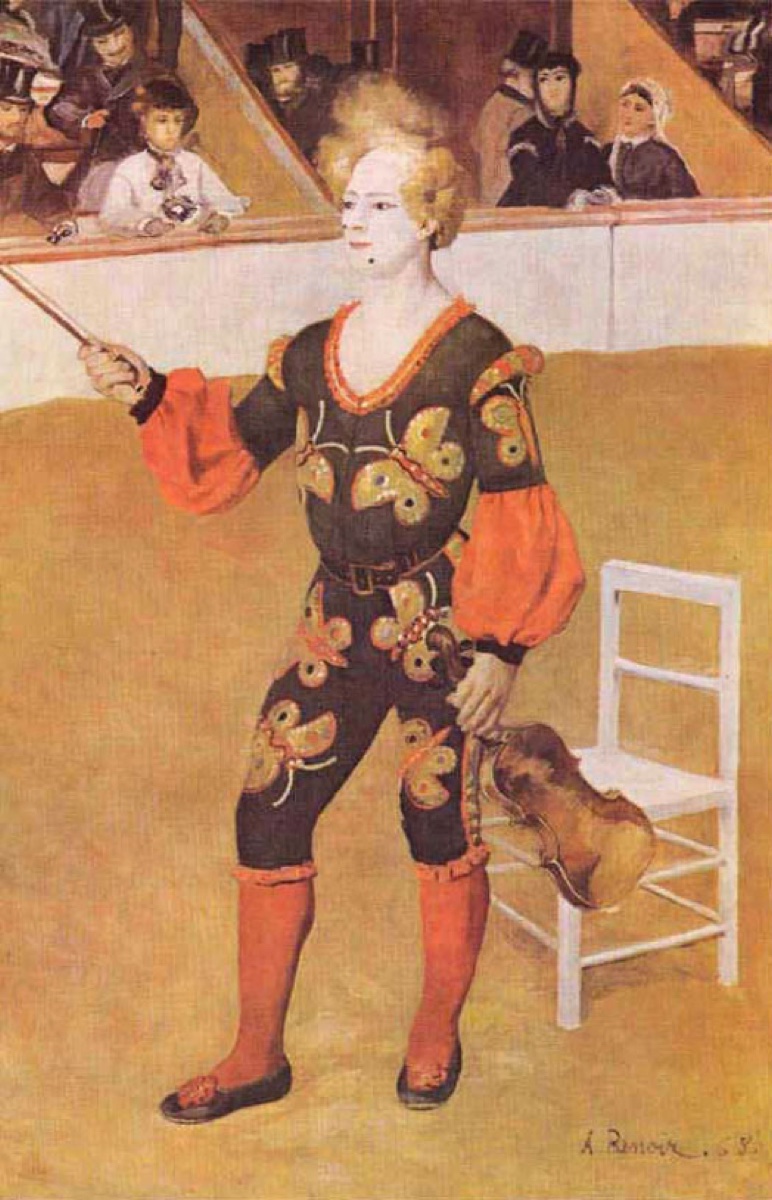
Painted in 1868 by Pierre-Auguste Renoir, Clown at the Circus bears witness to a pivotal period in the young artist's development, when he was merely twenty-seven years old. Long before the sun-drenched open-air dance halls and ball scenes that would make him famous, the painter explores here the fascinating world of popular entertainment and its protagonists. At the center of the composition, an acrobat stands in the arena, dressed in a black costume adorned with decorative yellow and orange motifs evoking butterflies or plant-like swirls. The red stockings and orange puffed sleeves create a striking contrast with the ochre background of the circular ring. Behind him, a crowd of spectators—men in top hats, women in crinolines—watches from the stands, their silhouettes blending into a hazy and intimate atmosphere.
The painting technique already reveals certain preoccupations that would animate the nascent Impressionist movement. Renoir works the material with a certain fluidity, particularly in the treatment of the public's faces, which almost dissolve into the shadows. The light, diffuse and theatrical, bathes the main figure in a golden clarity that sets him distinctly apart from the background. This attention to light effects and atmosphere foreshadows the future research of the Impressionist movement, though the execution remains still relatively academic. The realism of the costume and the individualization of the model—whose powdered face displays a melancholic expression—show the influence of Courbet and contemporary genre painting.
This canvas fits within the nineteenth-century fascination with the circus world and its marginal artists, a theme also explored by Degas, Toulouse-Lautrec, and Seurat. Housed in the Rijksmuseum Kröller-Müller in Otterlo in the Netherlands, this youthful work illustrates the versatility of a Renoir still seeking his artistic signature. It reminds us that Impressionism was not built through a sharp break with the past, but through a gradual maturation in which urban and popular spectacle occupied a central place in the observation of the modern world.
If you appreciate "Clown at the Circus" and other paintings by Pierre-Auguste Renoir, we offer you 10% off the purchase of an art poster from our partner europosters with the promo code GRANDSPEINTRES10.
Image license: faithful photographic reproduction of a two-dimensional public domain work of art.
Livres recommandés sur Pierre-Auguste Renoir
Sélection de livres de référence disponibles sur Amazon


