I don't have access to external databases or the ability to look up information about specific Wikidata items (Q138640508). To translate the title of this artwork, I would need you to provide me with the title in its original language. Could you please s
Artwork by Paul Klee • 1940
🖼️ Reproduce this artwork — 📗 Book on Paul Klee on Amazon
About this artwork - painting analysis
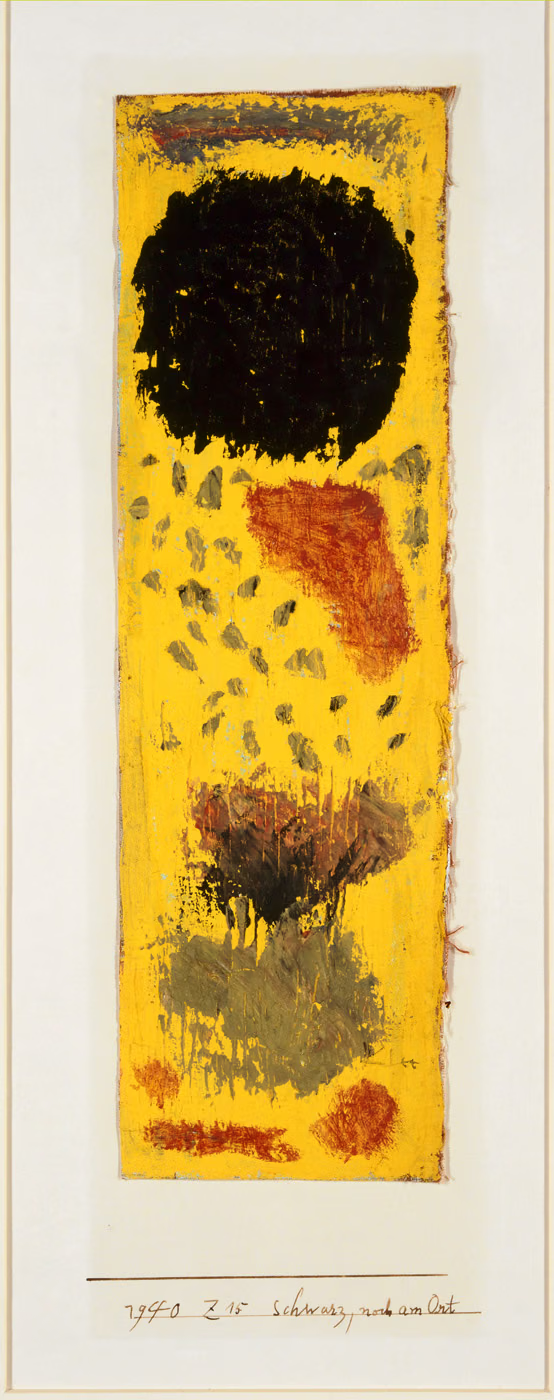
Created in 1940, one of the final years of Paul Klee's artistic output, this work bears witness to the expressive vitality of the Swiss-German master in the face of the illness consuming him. Over a striking, almost incandescent yellow background, abstract forms with irregular contours are organized: a large black circle dominates the upper portion, while red, grey, and brown spots punctuate the vertical composition. The elongated support immediately evokes the structure of a traffic light, an urban reference that Klee transposes into a deeply personal pictorial language. The grey impressions scattered across the yellow surface create a visual rhythm that animates the whole, conferring upon this painting an almost musical dimension, characteristic of the painter's synesthetic approach.
The technique employed reveals a direct and spontaneous gestuality: the thick colors appear to be applied with urgency, the irregular edges of the support and the paint runs testify to a creative process freed from academic conventions. This economy of plastic means is part of Klee's late period, marked by formal simplification and chromatic intensification. The violent contrast between the vibrant yellow and dark masses generates a dramatic tension, while areas of wear and overlapping material lend the whole a rich, almost tactile texture.
Created during the artist's Swiss exile, this work belongs to the ultimate production of a creator associated with the Bauhaus and abstract expressionism. Paul Klee, gravely afflicted by scleroderma, nonetheless pursues an audacious formal exploration, transforming everyday signs into universal symbols. The Kunstmuseum Basel, which houses this piece, holds one of the most important collections of the artist's work, allowing one to comprehend the evolution of his singular plastic language, oscillating between schematic figuration and poetic abstraction, which continues to influence contemporary generations.
If you appreciate "I don't have access to external databases or the ability to look up information about specific Wikidata items (Q138640508). To translate the title of this artwork, I would need you to provide me with the title in its original language. Could you please s" and other paintings by Paul Klee, we offer you 10% off the purchase of an art poster from our partner europosters with the promo code GRANDSPEINTRES10.
Image license: faithful photographic reproduction of a two-dimensional public domain work of art.