
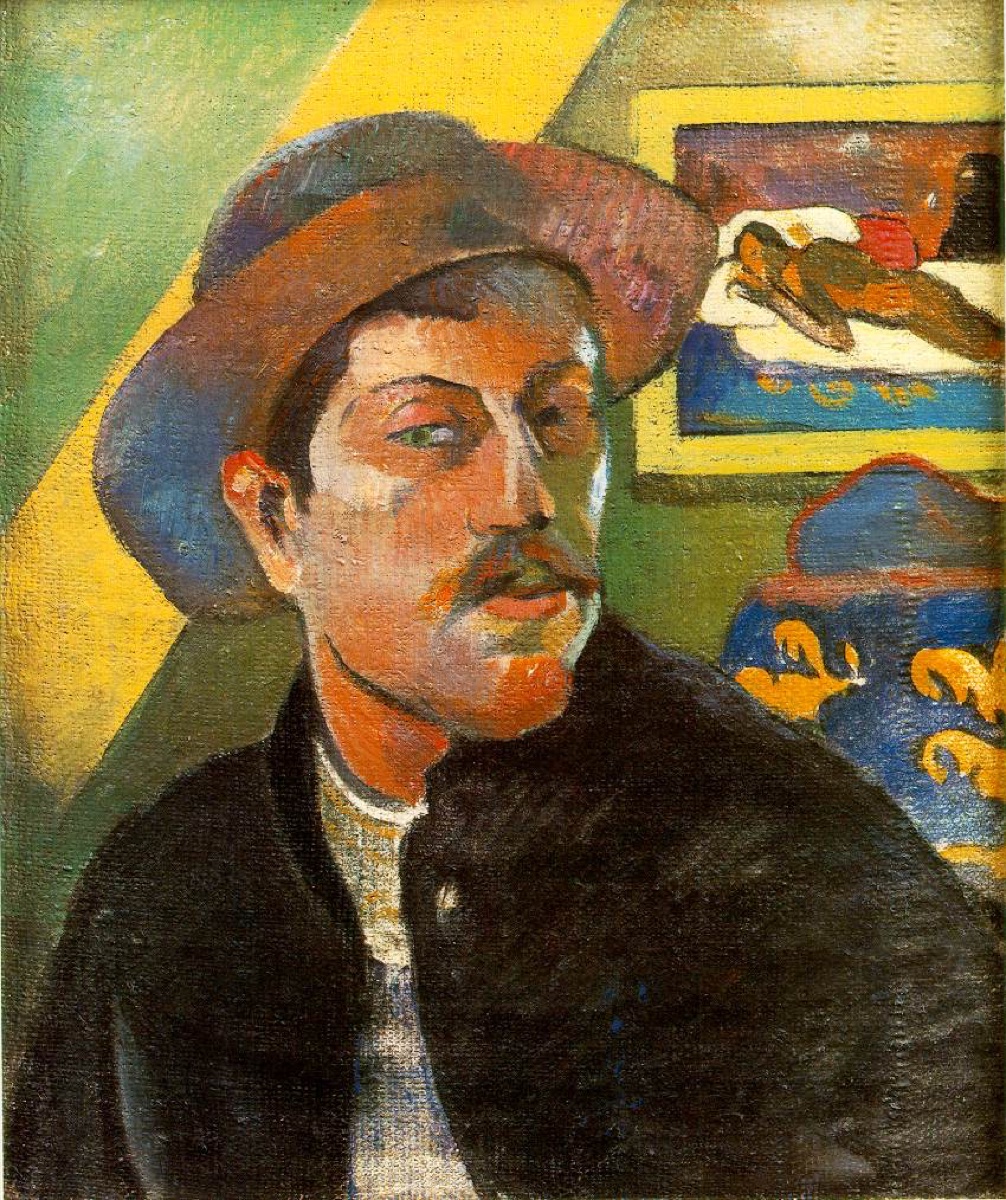
Self-Portrait
Artwork by Paul Gauguin • 1894
🖼️ Reproduce this artwork — 📗 Book on Paul Gauguin on Amazon
About this artwork - painting analysis
Completed in 1894, Paul Gauguin's Self-Portrait bears witness to a pivotal period in the trajectory of the post-impressionist master, between two Tahitian stays that would profoundly mark his work. The painter represents himself here frontally, with an intense gaze slightly averted to the side, wearing a dark hat that frames his face with features marked by a full mustache. The composition incorporates behind him two of his own paintings – a meta-pictorial detail that reveals his determination to display his identity as an artist while creating a subtle dialogue between different levels of representation.
The chromatic palette reveals the full singularity of Gauguin's style: warm ochres and luminous oranges structure the face, while the background unfolds a mosaic of greens, brilliant yellows, and deep blues. This juxtaposition of pure colors, applied in vigorous flat areas, is part of the synthetist approach that Gauguin theorized at Pont-Aven. The contours outlined in black accentuate the flatness of the composition and give the whole work a quasi-decorative dimension, far from academic portrait conventions. The background, far from being mere decoration, actively participates in the overall chromatic balance and evokes the painter's symbolist investigations.
Housed in the Musée d'Orsay in Paris, this painting of modest dimensions – 46 x 38 centimeters – nonetheless concentrates all the ambition of an artist seeking primitive authenticity and pictorial renewal. Painted upon his return from Tahiti, this self-portrait marks an assertion of self after years of misunderstanding and material hardship. Gauguin presents himself here not as a bohemian painter but as a creator conscious of his worth, integrating his own works as a visual manifesto of his genius. This mise en abyme prefigures modern questioning about the very nature of artistic representation, making this portrait far more than a simple physiognomic study.
If you appreciate "Self-Portrait" and other paintings by Paul Gauguin, we offer you 10% off the purchase of an art poster from our partner europosters with the promo code GRANDSPEINTRES10.
Image license: faithful photographic reproduction of a two-dimensional public domain work of art.


