
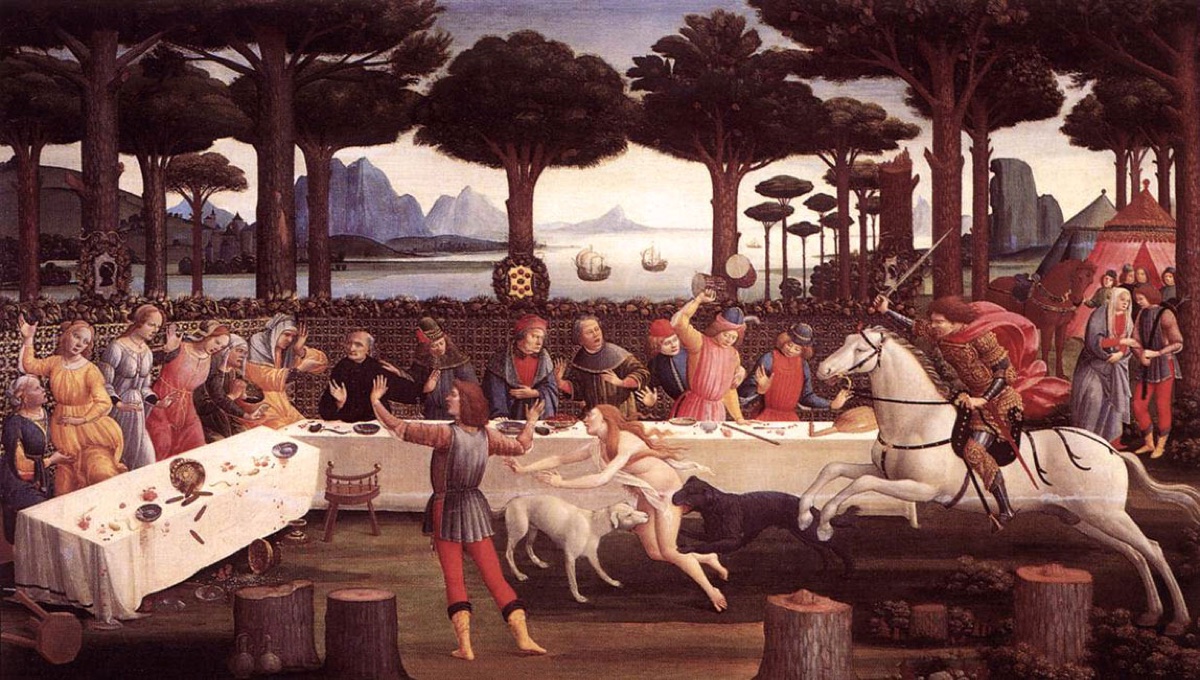
The Story of Nastagio degli Onesti (Third Episode)
Artwork by Sandro Botticelli • 1483
🖼️ Reproduce this artwork — 📗 Book on Sandro Botticelli on Amazon
About this artwork - painting analysis
Commissioned by the wealthy Florentine Pucci family to celebrate a wedding, Sandro Botticelli's The Story of Nastagio degli Onesti (3rd episode) illustrates in 1483 the spectacular denouement of a tale drawn from Boccaccio's Decameron. This tempera on panel, now housed in the Museo del Prado in Madrid, forms part of a narrative cycle of four paintings recounting the edifying story of a young nobleman from Ravenna confronted with a supernatural vision that will change his romantic destiny. In this episode, Nastagio organizes a sumptuous banquet to convince the young woman who spurns him, recreating the macabre scene he witnessed: a knight eternally pursuing a cruel lady.
The composition revolves around a long table set beneath an elegant pergola where the guests, seized with terror, witness the fantastic apparition. The knight on his white steed emerges dramatically on the right, while the naked young woman collapses before him, pursued by ferocious dogs. Botticelli masterfully orchestrates this dual scene – the worldly feast and the infernal hunt – creating palpable narrative tension. The shimmering colors of Renaissance garments contrast with the darker tones of the nightmarish vision, while the background presents a majestic pine grove opening onto a bay studded with sailboats, the hallmark of the Florentine master's idealized landscapes.
Botticelli's technique here reaches remarkable maturity, characteristic of Florentine Quattrocento. The sinuous and elegant lines, the delicacy of refined facial features, the attention to decorative details in costumes and tableware testify to his ornamental genius. The architectural perspective of the pergola and the rhythmic arrangement of trees demonstrate his mastery of the spatial innovations of the Italian Renaissance.
This didactic work, intended to instruct as much as to decorate a Florentine palazzo, perfectly illustrates how Renaissance secular art instrumentalized medieval literature to convey moral messages about courtly love and the dangers of emotional cruelty, thus marking Botticelli's lasting influence on the narrative painting of his era.
If you appreciate "The Story of Nastagio degli Onesti (Third Episode)" and other paintings by Sandro Botticelli, we offer you 10% off the purchase of an art poster from our partner europosters with the promo code GRANDSPEINTRES10.
Image license: faithful photographic reproduction of a two-dimensional public domain work of art.


