The Story of Nastagio degli Onesti (Second Episode)
Artwork by Sandro Botticelli • 1483
🖼️ Reproduce this artwork — 📗 Book on Sandro Botticelli on Amazon
About this artwork - painting analysis
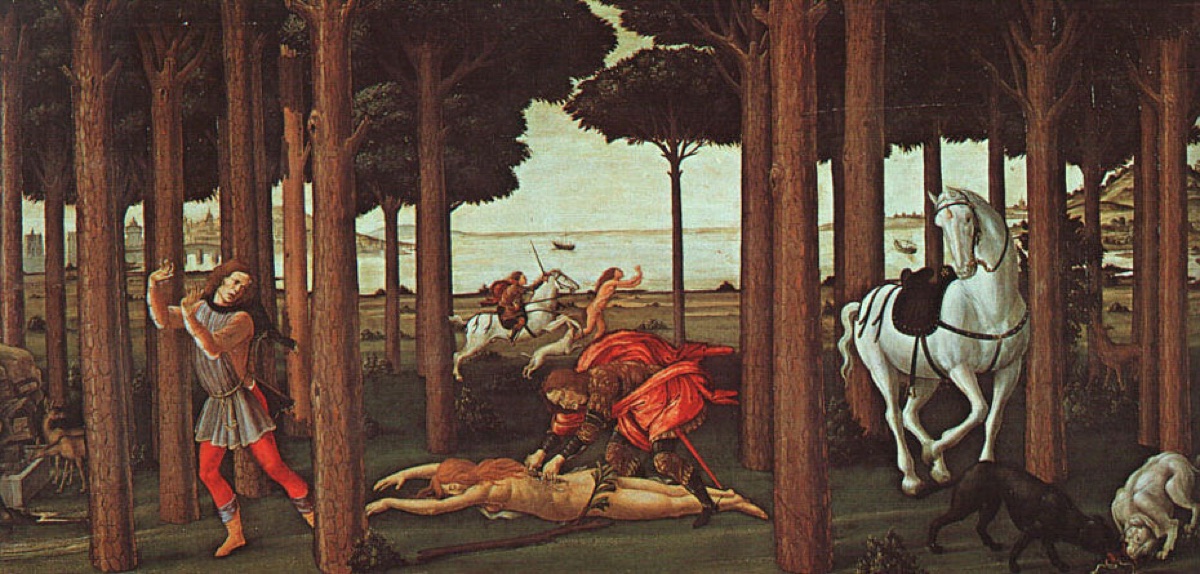
Sandro Botticelli signed a fascinating narrative work in 1483 with The Story of Nastagio degli Onesti (2nd episode), the central panel of a cycle of four paintings illustrating a tragic tale from Boccaccio's Decameron. This prestigious commission, created to celebrate the marriage of Giannozzo Pucci and Lucrezia Bini, transposes with striking dramatic intensity the medieval account of cursed love and eternal punishment. The Florentine painter deploys all his talent here to transform a cruel tale into a visual spectacle of hypnotic power.
The composition unfolds in an elegant pine grove whose vertical trunks structure the space like the columns of a natural theatre. At the center, a violent scene captures the moment when a red-clad horseman strikes a naked woman lying on the ground, an infernal punishment that repeats eternally in this forest. On the left, Nastagio, dressed in red and grey, watches horrified at this supernatural apparition, while on the right a white horse without a rider and hounds complete this macabre hunt. The background reveals a luminous maritime landscape where the ghostly pursuit continues, creating remarkable narrative depth. Ochre, blood-red, and brown tones dominate, contrasting with the clarity of the sky and the spectral whiteness of the horse.
Botticelli demonstrates here his mastery of the serpentine line and atmospheric perspective, characteristics of early Florentine Renaissance. His precise drawing, inherited from his training as a goldsmith, sculpts the drapery with an elegance that paradoxically softens the violence of the subject. The tempera on wood allows these subtle transitions between shadow and light, conferring upon the bodies an unreal grace despite the horror depicted.
Housed in the Museo del Prado since the nineteenth century, this panel testifies to Renaissance interest in vernacular literature and moralizing narratives. Botticelli transforms the warning against feminine pride into a sophisticated pictorial ballet, demonstrating how Florentine Quattrocento art knew how to reconcile didactic narration with refined aesthetic pursuit.
If you appreciate "The Story of Nastagio degli Onesti (Second Episode)" and other paintings by Sandro Botticelli, we offer you 10% off the purchase of an art poster from our partner europosters with the promo code GRANDSPEINTRES10.
Image license: faithful photographic reproduction of a two-dimensional public domain work of art.